DISC in the Workplace: Why Behaviour Styles Explain Half Your Communication Problems
Most team friction isn't a personality clash, it's a style mismatch. Here's how DISC behaviour styles explain what goes wrong at work, and how to adapt without changing who you are.

Most team friction isn't a personality problem
When two people in the same team consistently frustrate each other, the usual explanation is a personality clash. In practice it is almost always a style mismatch: two people who work at different speeds, prioritise different things, and read the same email in completely different ways.
Neither person is wrong. They are simply wired to communicate differently, and nobody has ever named the difference out loud.
DISC is one of the most practical ways to name it. It is not a personality test and it does not put anyone in a box. It describes four observable behaviour styles: how a person tends to communicate under normal conditions, and how they shift when pressure rises.
The four styles at a glance
- Dominance (D) — direct, decisive, results first. Wants the bottom line before the background, moves fast, and can read as blunt.
- Influence (I) — enthusiastic, expressive, people first. Thinks out loud, persuades through story, and can read as scattered.
- Steadiness (S) — calm, loyal, consistency first. Listens more than speaks, dislikes sudden change, and can read as slow to move.
- Conscientiousness (C) — analytical, precise, accuracy first. Wants the detail and the evidence, and can read as critical.
Most people have one dominant style and a secondary one. Most teams are also badly unbalanced. A team of high Ds moves quickly and bruises people along the way. A team of high Cs produces excellent work slowly. Neither is a functioning team without the other styles in the room.
Where it actually goes wrong
Email. A high D sends three words. A high C replies with nine paragraphs and an attached spreadsheet. Both walk away irritated, and the task is still unclear.
Meetings. The high I wants to talk it through and build energy. The high C wants the paper circulated beforehand so the discussion can be precise. Run the meeting one way and half the room disengages.
Feedback. A D delivers feedback fast and directly, intending to help. An S hears it as a personal blow and goes quiet for a week. The D concludes the S can't take feedback. The S concludes the D doesn't care.
Change. A restructure lands fine with the Ds and Is, who see opportunity. The Ss, who value predictability, are the ones who quietly start looking for another job.
None of this is fixed by asking people to be more like each other. It is fixed by making the difference visible and giving the team a shared language for it.
Three things that make a difference
1. Know your own default first. Most conflict management fails because it starts by diagnosing everyone else. Start with your own style, your own pressure response, and the two or three habits that cost you the most credibility with people who are not like you.
2. Adapt without imitating. Adapting is not pretending to be a high I when you are a high C. It is giving a colleague the format they can absorb: a one-line summary at the top of the detail, a heads-up before a change rather than after it, a decision made in the room rather than by email afterwards. Small adjustments, applied consistently, do more than any personality workshop epiphany.
3. Agree team norms, not personal fixes. The strongest outcome of a DISC session is a short list of agreements the team writes itself. For example: decisions get summarised in writing within 24 hours; bad news is shared in person, not in a group chat; new processes get a week of warning. Norms hold because they belong to the team, not to the facilitator.
The point of DISC is not to label people. It is to stop wasting energy being surprised by behaviour that is entirely predictable.
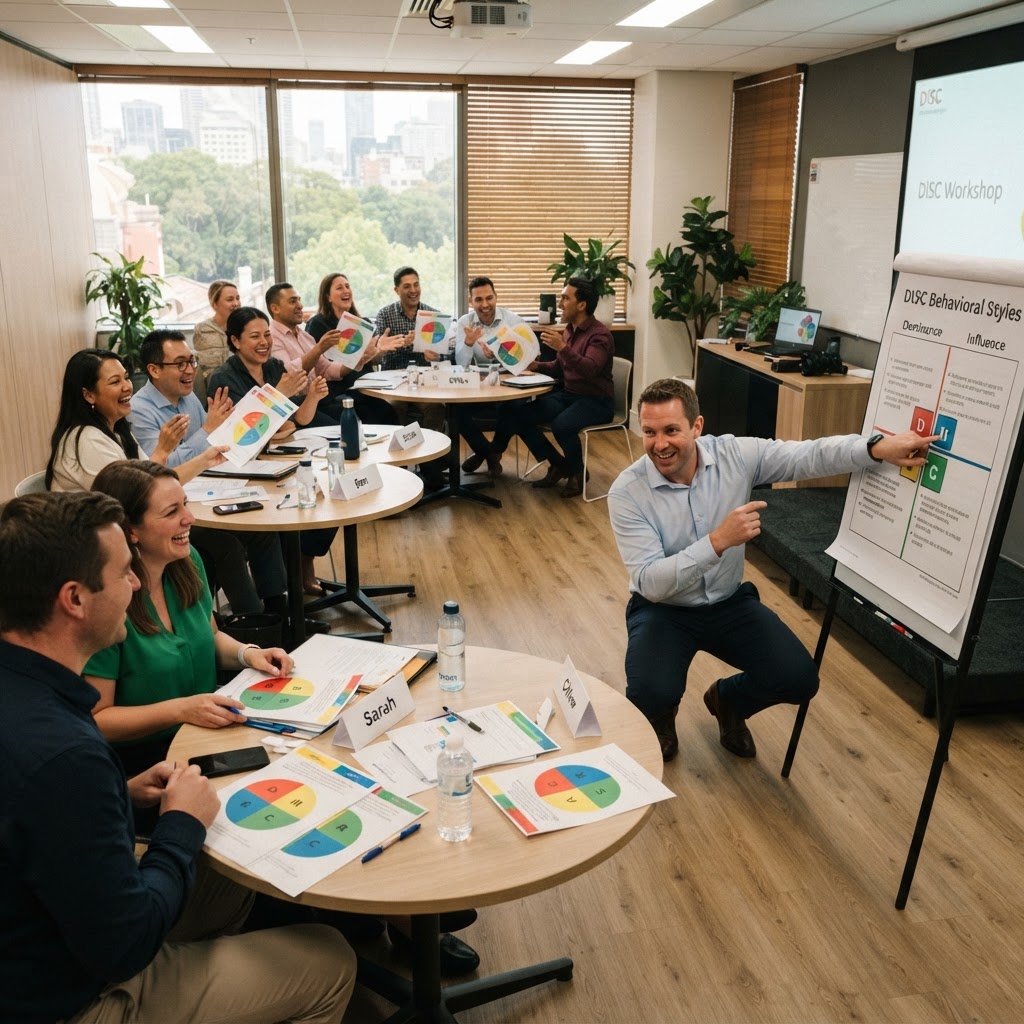
What a good DISC workshop looks like
A DISC session that changes nothing is easy to spot: everyone gets a coloured report, laughs at their own description, and returns to exactly the same patterns on Monday.
A useful session is facilitated, works on real scenarios from your own week, and ends with the team naming two or three specific behaviours they will change. It should also include the managers, because a team cannot adapt to a leader who has not adapted to them.
Used well, DISC becomes the language a team uses to solve disagreements without making them personal. That is worth far more than a report.
Want this for your team? MTRAIN runs DISC-based communication workshops for teams across Australia, New Zealand and the Pacific, delivered online, blended or in person. Talk to us about a workshop or find the right programme.
MTRAIN Team
Leadership Development Specialists
MTRAIN delivers practical leadership and communication training across Australia, NZ & the Pacific.
You Might Also Like
Continue your learning journey with these related articles